
AI search measurement: readiness, visibility, and revenue
Measure AI search across readiness, competitive visibility, and revenue evidence. A practical approach for marketing leaders deciding where to focus.
By Andrew Riker, Founder, Surfaced
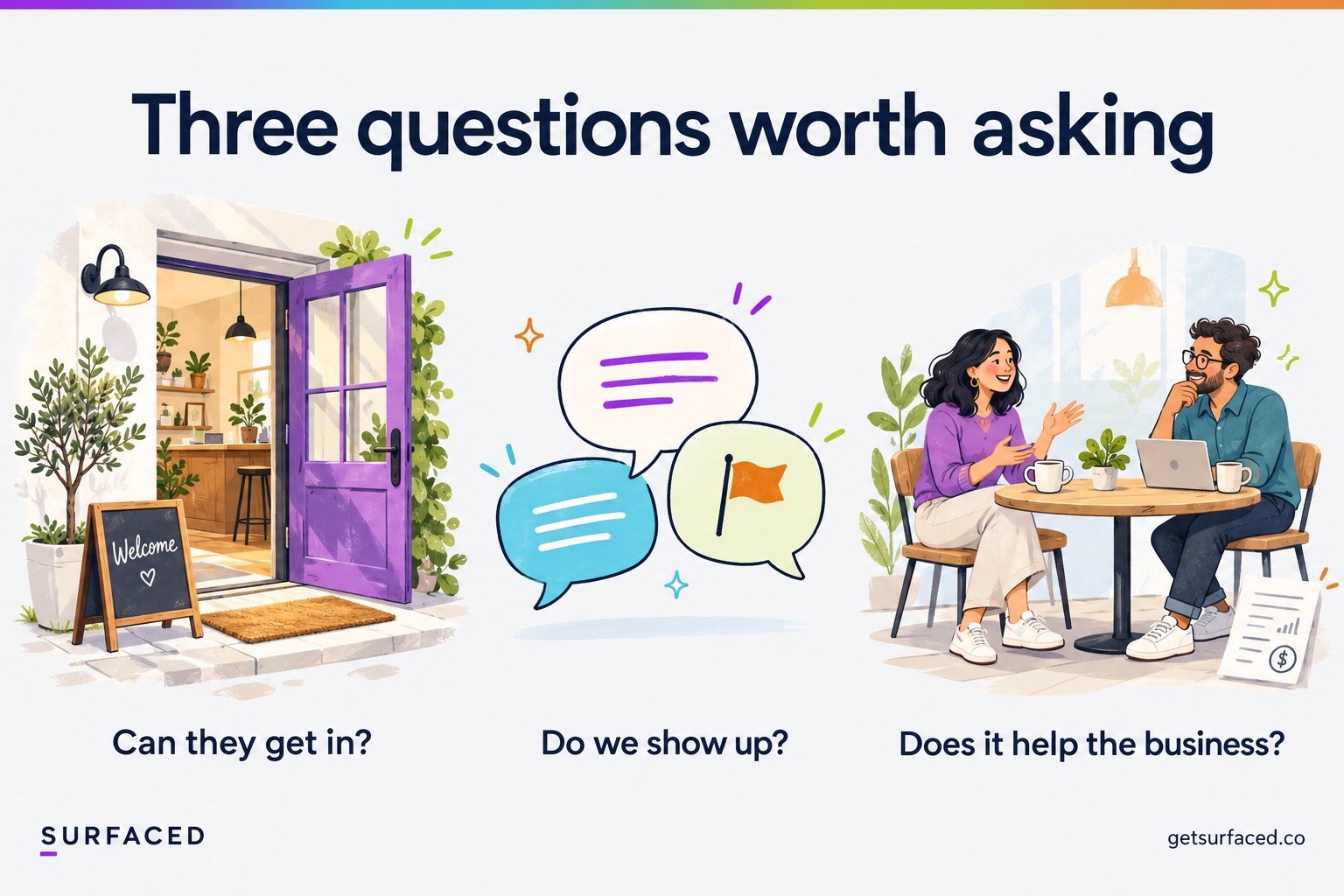
A client recently asked me whether they should focus their AI search effort on the top, middle, or bottom of the funnel.
My recommendation was to start with the middle and bottom. When revenue is the priority, I want to understand the questions people ask when they are evaluating an approach, comparing providers, or working out whether a purchase makes sense. I also want the problem-aware questions that connect closely to what the company actually sells.
That question gets at something bigger than which prompts to track. Before we measure AI search, we need to agree on what we want the work to accomplish.
A dashboard can help us see what is happening. It cannot choose our priorities, get a subject matter expert to review the content, or convince sales to capture what buyers are telling them. Measurement supports strategy and execution. There is still a lot of work between opening the report and improving performance.
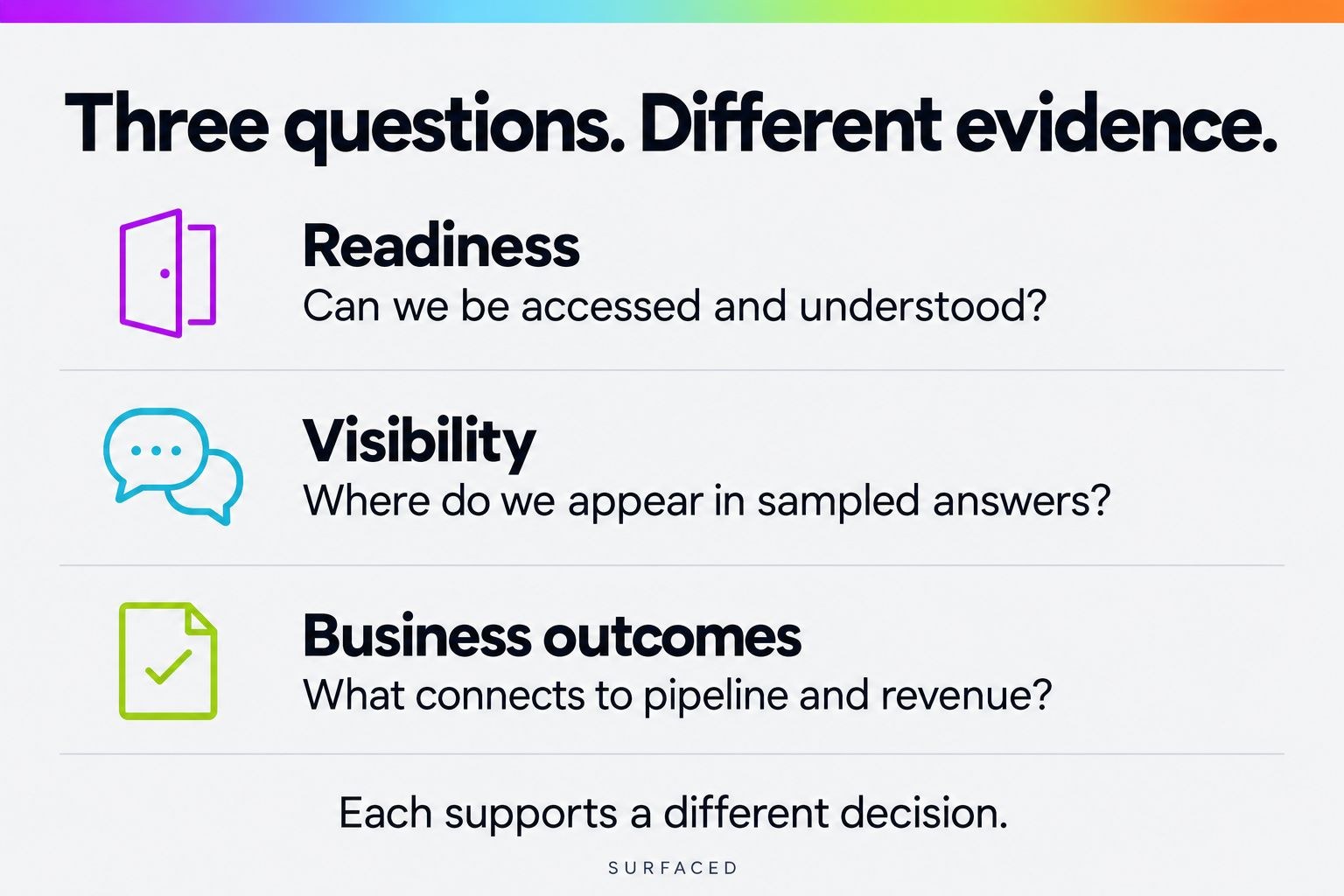
I break that measurement into three layers: AI readiness, competitive visibility, and revenue attribution and influence. Each gives us a different kind of evidence. Together, they help us decide where to put our effort and explain what we know with some honesty.
Start with the buying conversations you want to influence
Broad informational content has a tougher job when someone can get a sufficient answer without visiting a website.
Pew Research Center's analysis of browsing activity from 900 U.S. adults in March 2025 found that users clicked traditional search results on 8% of visits with an AI summary, compared with 15% without one. That is evidence of a click-through gap in that Google sample, rather than a forecast for every business or platform. Pew also reconstructed search results in April, so the results it collected could differ from what participants originally saw. [1]
For me, that reinforces the need to be selective. If the team has limited capacity and needs to support pipeline, I would prioritize questions with a clear connection to a buying decision.
Take a hypothetical managed IT provider. "What are managed IT services?" is a different opportunity from "Should we outsource IT support or hire another internal team member?" The second person has a problem to solve, even if they have never heard of your company. Questions about transition risk, service coverage, cost, and provider fit move that conversation further along.
Broad education still has a role in building familiarity and explaining unfamiliar categories. My recommendation is about sequencing the work. Cover the questions that help a relevant buyer move forward, then expand with purpose.
Layer one: can they come through the front door?
AI readiness starts with a simple question: can the relevant systems access your website and retrieve useful content?
I want to know whether important pages are accessible, whether the main copy is readable, and whether security controls are getting in the way. I also want to understand which crawlers we are talking about. OpenAI, for example, distinguishes its search crawler, OAI-SearchBot, from GPTBot, which relates to model training. Those are separate controls, so "we allow AI bots" needs a little more detail. [2]
Then I look at the content itself. Is it clear what the company does, who it helps, and where its expertise sits? Does the site answer the questions buyers actually have? Does it provide evidence for its claims?
Content and embedding analysis can help identify related topics, thin coverage, and gaps. I use that analysis as a diagnostic. It does not expose a secret topical authority score inside ChatGPT, and similarity between pages does not establish that the content is accurate or convincing. Someone still needs to read it.
For our hypothetical IT provider, this could mean discovering that the site has plenty of general technology articles but very little about switching providers without disrupting operations. That is a useful finding because it gives the team something specific to investigate and improve.
The readiness report should show the important barriers, the pages affected, and who owns the fix. A rising audit score is encouraging. The practical value is knowing which obstacles you have removed and which ones still need attention.
Readiness metrics worth considering
- Page accessibility: The number or percentage of priority pages the relevant AI search crawlers can access.
- Content coverage: The number or percentage of important buyer questions your content answers usefully.
- Information accuracy: The number or percentage of reviewed pages with accurate, current information.
Define the priority pages and buyer questions first, and keep the review criteria consistent. Otherwise, a better score can simply mean you changed the checklist. Removing an access barrier gives the content a chance to be used; it does not establish demand.
The three views below belong together. Each supports a different decision, and none guarantees the next outcome.
Layer two: where do we appear in the conversation?
Once we have looked at readiness, I want to understand our position against competitors in the answers buyers could encounter. We can track this while the team works on the site; there is no need to wait for a perfect audit score.
This is where prompt measurement helps. Build a set of questions around the problems, comparisons, and decisions that matter to your audience. Sales calls, customer interviews, objections, and existing search data are useful inputs. A list generated entirely from what we wish buyers were asking deserves a second look.
For the IT provider, I would include questions about outsourcing versus hiring, comparing service models, and choosing a provider with experience in a specific industry. I would separate branded questions from unbranded ones so existing awareness does not get mistaken for discovery.
Within that sample, we can measure how often the brand appears, its share of mentions relative to competitors, and its share of citations. We should also read the answers. Are we described accurately? Are we recommended for work we actually want? Is the citation pointing to a page that helps someone evaluate us?
A mention and a citation tell us different things. A brand can be named without its website being cited. A page can be cited without the company being recommended as a provider.
The measurement needs consistent definitions, too. State the prompt set, platforms, dates, and denominator behind each percentage. Repeat observations and record changes to the sample. Call it share of voice within the tracked questions, rather than treating it as a census of the market.
If a competitor repeatedly appears for transition-risk questions and we do not, I want to investigate the difference. The report gives us a question worth answering. It does not prescribe the fix on its own.
Visibility metrics worth considering
- Mention rate: The percentage of sampled answers that name your brand.
- Recommendation rate: The percentage that suggest your brand as a relevant option.
- Citation rate: The percentage that cite your website as a source.
- Share of mentions: Your brand's share of mentions across the defined set of tracked brands.
- Answer accuracy: The percentage of reviewed answers about your brand that describe it correctly.
State how you count repeated mentions, missing answers and failed runs. Keep the questions and testing conditions consistent, and record observation dates. These numbers describe the tracked sample, not your overall market share.
Read the answer, especially when it is about you
A report can count your name and still miss the part a buyer reads. A branded answer might repeat an old complaint, outdated product information or an inaccurate claim. Those are risks to check, not reasons to assume every answer is negative.
Review brand-only questions separately from reviews, comparisons and complaints. Open the cited sources and check whether they support the answer. A legitimate complaint and a false description need different responses. One may require work on the customer experience; the other needs an accuracy investigation. Give someone responsibility for that next action.
Layer three: what connects to pipeline and revenue?
Eventually, someone will ask what the AI search investment is doing for the business. Fair question. "Look, the line went up" needs some supporting material.
I want identifiable AI referral traffic and its conversions in the reporting. I also want to know what buyers tell us and what happens to those opportunities afterward.
That means working with sales and RevOps. Ask how someone first heard about the company. Where it fits the conversation, ask what helped them evaluate their options. An open response can surface something a channel dropdown misses: "We asked ChatGPT for a shortlist, looked at your case studies, and then a colleague recommended you."
Keep that answer with the lead or account. Preserve the buyer's words alongside any standardized category, and connect the record to opportunity stage and eventual revenue. Track how often you collect an answer, too. Five responses out of ten conversations and five out of five hundred tell very different stories.
I would report directly tracked AI conversions and buyer-reported AI influence separately. If an opportunity appears in both, account for the overlap before adding anything together. Pipeline also needs to stay distinct from closed-won revenue.
Business metrics worth considering
- Identifiable AI referral visits and leads: Visits and inquiries you can trace to an AI source.
- AI referral conversion rate: The percentage of those visits that become a defined conversion, such as a qualified lead.
- Buyer-reported influence: Buyers who say AI helped them discover or evaluate you, alongside the percentage of buyers who answered the question.
- Associated pipeline and revenue: Opportunity value and closed-won revenue linked to those signals, reported separately and deduplicated.
- Estimated incremental lift: Additional business a credible comparison test suggests the work produced.
Direct traffic and branded search trends can help identify patterns worth investigating. They are supporting signals, not automatic evidence of AI-attributed revenue. Pick the measures that help you decide what to fix, where to focus or whether to keep investing.
Will a form field reconstruct every influence on a buying decision? I wish.
It gives us another piece of evidence. A buyer saying AI helped them find us supports an influence claim. It does not prove that the sale would have disappeared without AI. Establishing incremental impact requires a stronger test, such as a credible comparison group, with the other changes and limitations made explicit.
What happened because of the work?
Incrementality asks how much extra business the work produced compared with what would have happened without it. We do not get to watch the same buyer live both versions, so the comparison has to do some serious work.
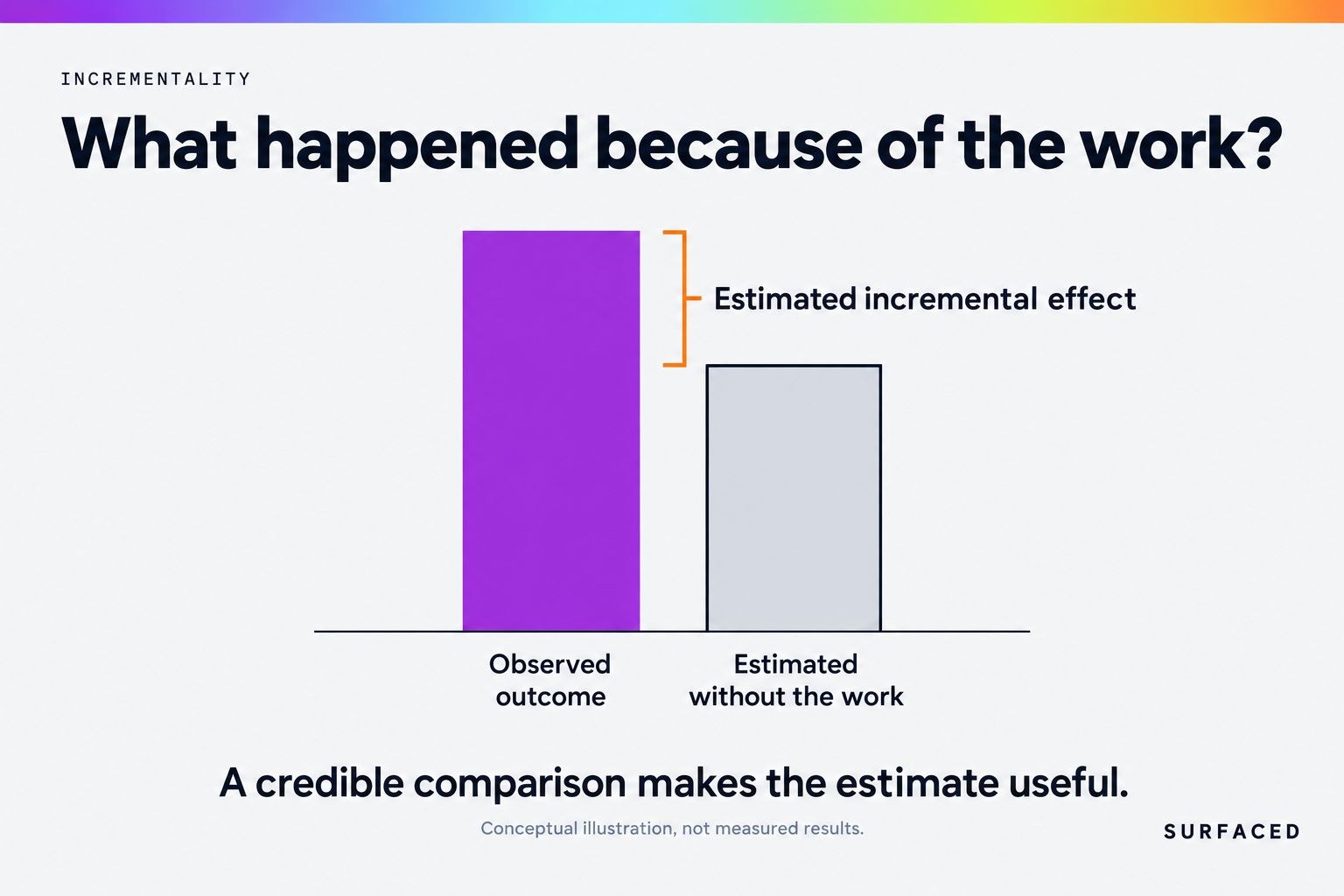
For our hypothetical IT provider, start with a specific change: improve the evidence about switching providers without disrupting operations. Agree on the business outcome and what result would justify expanding the work before the test starts.
Then look for a credible comparison that can remain unchanged. Randomize where feasible. Otherwise, explain why the groups are comparable, check their prior trends, and account for other campaigns and spillover. Allow enough time for the buying cycle and enough volume to learn something.
Even a credible result may show that the content helped across search and sales. Separating the AI contribution is another claim that needs its own evidence. A page that also ranks in Google and gets used by the sales team should not have all its impact assigned to AI.
If the business lacks enough volume or a credible comparison, report what changed, what buyers told you and what remains uncertain. An inconclusive result is allowed. Use it to choose the next useful test.
What about ChatGPT visits showing up as direct?
This is a fair concern to investigate. Google describes direct traffic as visits without a clear referral source and lists missing traffic information among the reasons it occurs. [3]
An AI-originated visit that arrives without usable source information may therefore be difficult to identify. A buyer can also discover you in an AI answer and return later by typing your address or searching your brand.
But a rise in direct traffic cannot tell us how much came from AI. I would not turn that increase into an AI revenue number. If referrals change suddenly, check the links, tagging, redirects, consent behavior, and device patterns before deciding what happened.
The useful response is to combine the signals we can observe, document the gaps, and keep collecting buyer evidence. There is no universal percentage of hidden AI revenue I would apply to a client's business.
Keep a change log beside the report
Record content changes, campaigns, tagging changes, prompt-set revisions and known platform changes. When a chart moves abruptly, check whether the underlying behavior changed or the collection method changed. Compare platforms and inspect the actual answers before attributing a citation drop to your content.
Keep a note of reporting breaks so a tracking problem does not become a performance story by accident.
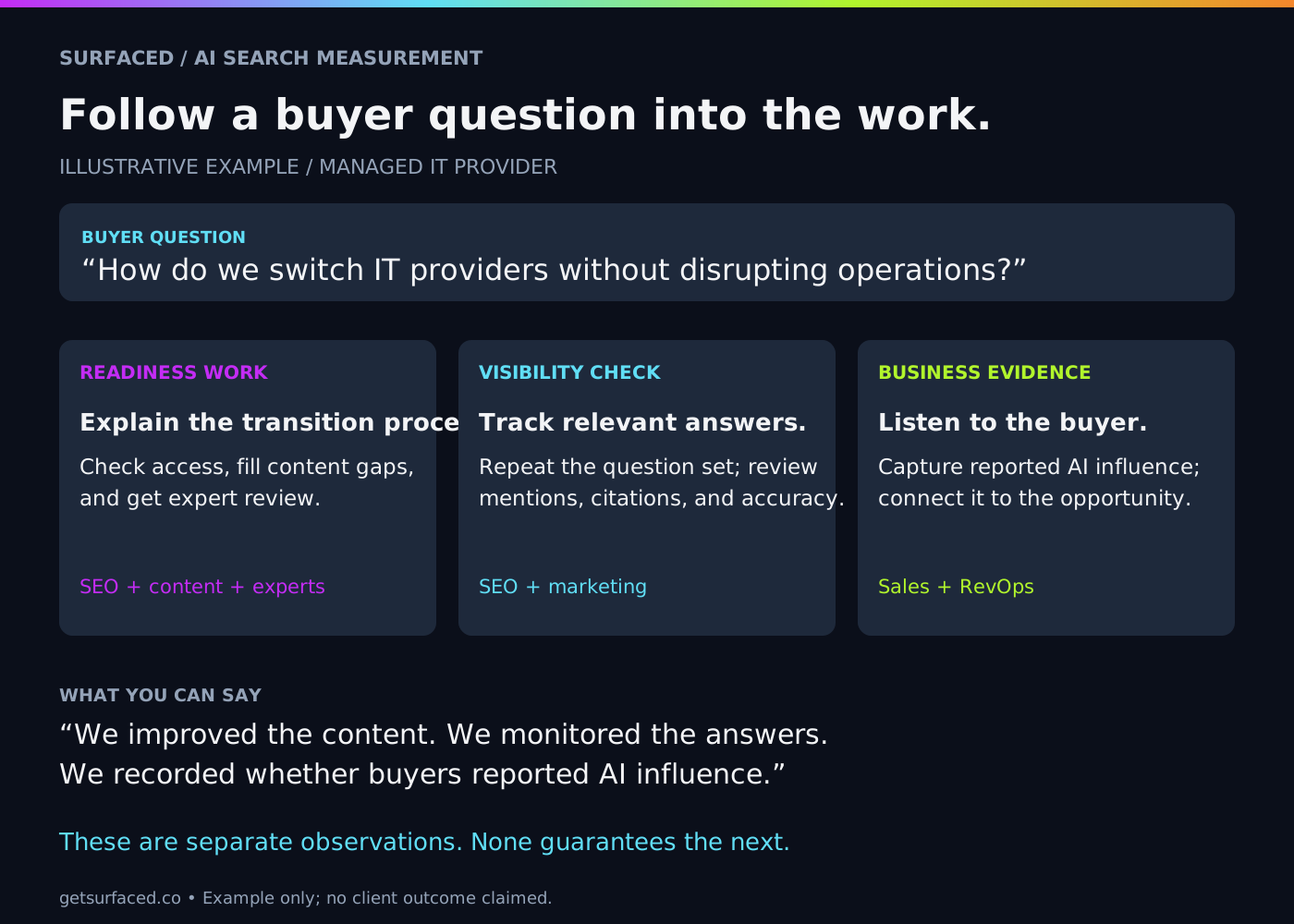
For the managed IT example, that means keeping the work and the evidence connected without assuming a sale will follow.
The team creates the performance
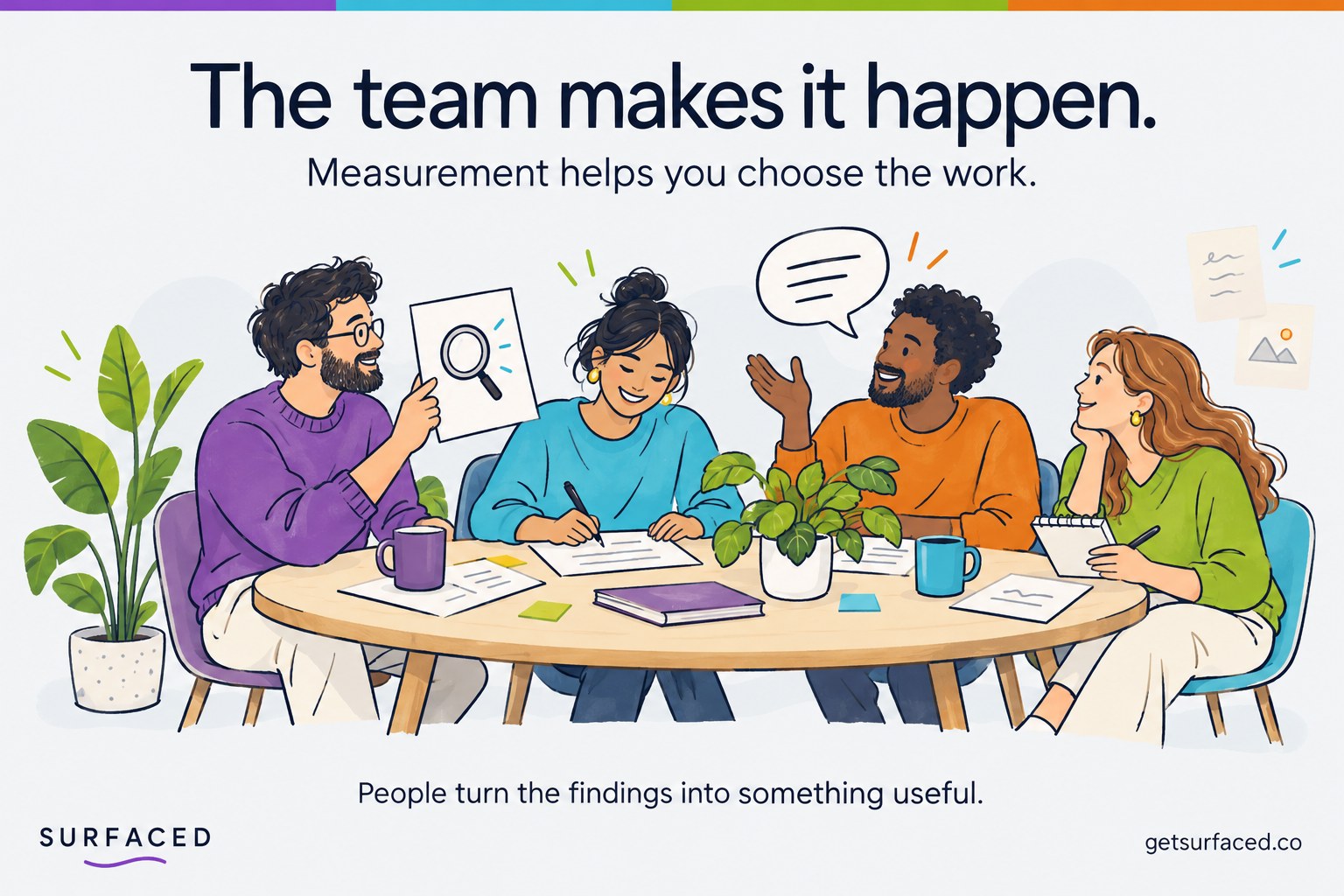
Imagine the reporting identifies weak visibility around switching IT providers. SEO can investigate access and content gaps. Product marketing can clarify the offer. Subject matter experts can explain the transition process. Sales can contribute the objections that come up in real conversations. RevOps can help connect those conversations to opportunities.
That is why measurement needs a working relationship across the team. Someone has to own the next action, and the people doing the work need time and support to deliver it.
In the next review, I want to hear what changed, what evidence followed, and what remains uncertain. If access improved but visibility stayed flat, investigate that. If visibility improved but qualified conversations did not, revisit the audience, offer, and content. A report should help us choose the next useful piece of work.
For agencies, agree with the client on those responsibilities early. Be specific about what your team can deliver and where you need their technical team, experts, salespeople, or leadership involved. It makes the reporting conversation much more productive.
There is no silver bullet here. Better measurement can make the hard work more focused, and it can help an internal champion explain why that work deserves attention. It still takes people to turn the findings into something a buyer finds useful.
If you are trying to decide which buying questions to prioritize or what your current reporting can tell you, bring me one question your team is stuck on. I am happy to think it through with you.
Sources
1. Pew Research Center: Google users are less likely to click on links when an AI summary appears in the results, July 22, 2025.
2. OpenAI: Overview of OpenAI crawlers, accessed October 14, 2026.
3. Google Analytics Help: Understand (direct) / (none) traffic, accessed October 14, 2026.