
Your AI visibility score starts with the prompts you choose
Before a visibility score tells you anything useful, you need to know what the prompts measure. How prompt mix shapes AI search scores and what to choose instead.
By Andrew Riker, Founder, Surfaced

I came across a clip of Gaetano Nino DiNardi and Ross Simmonds talking about the difference between being visible and being recommended in AI search. It reminds me how I approach the question when clients ask me how I choose prompts.
What went into the prompts?
Are they branded or non-branded? Informational? Comparisons? Specific pain points? Who are they supposed to represent, and how are they weighted? It can all get pretty complicated and fuzzy.
Because before a visibility score can tell you anything useful about your business, you need to understand what you've asked it to measure. You're setting the goalposts in this phase!
My take: prompt composition is one of the most consequential strategy decisions in an AI search program (operations I'd argue is more important, though). It determines which parts of the buying process you're watching. And when that score becomes the number leadership cares about, it starts influencing what your team writes, fixes, funds, and reports.
That's a lot of responsibility for a prompt list someone might have accepted during onboarding. Sometimes auto-generated prompts is OK for directional use, but if you want any sort of rigor, it requires a bit more.
Gaetano has made this practical in his own writing about tracking a guide to non-human identity management. He described an informational question where none of the brands in the sample were being recommended. His point was that a dashboard could make the brand's absence look like a performance problem, even though the answer wasn't recommending vendors at all. I love his takes.
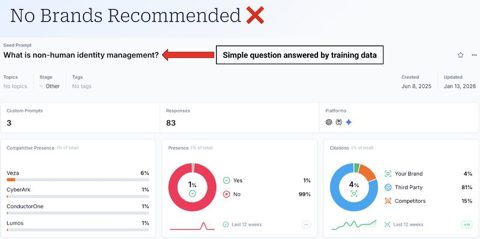 Tracking a guide to non-human identity managementGaetano Nino DiNardi · LinkedIn
If you're asking for an explanation, a useful answer may simply explain the thing. Judging that answer on whether it recommends your product needs a pretty good justification.
Imagine asking everyone walking into a Target whether they're ready to buy a refrigerator. You'll get a different result if you ask the people already standing in the appliance department. Neither group represents everyone in the building, and that's the whole shooting match.
Your prompt set makes a similar choice.
Consider these illustrative questions for a CRM company:
| Prompt | What I'd use it to assess |
|---|---|
| How does lead routing work? | Educational presence and useful source citations |
| How can a small sales team stop losing inbound leads during handoffs? | Presence around a problem the product addresses |
| Which CRMs support lead routing for a 20-person sales team? | Inclusion and fit in a relevant shortlist |
| How does Brand A compare with Brand B on routing and implementation? | Competitive positioning and stated tradeoffs |
| Does Brand A support our existing integrations? | Accuracy when someone is already evaluating the brand |
Those are different measurement jobs. Branded versus non-branded is also a separate dimension from intent: a comparison can name your brand or ask the system to discover alternatives for you.
Roll everything into one score and you lose the distinction between being used as a source, being introduced to a buyer, and being described accurately after the buyer already knows your name.
There's also a difference between a brand-unaware buyer and a brand-aware buyer. Someone can understand their problem without knowing your company exists. A non-branded prompt lets you see whether your brand enters that person's consideration set. A branded prompt helps you examine what happens once it's there.

And that consideration set keeps changing as the person shopping finds out more and more information. A buyer starts with a problem, discovers a few logos, learns about features they hadn't considered, and asks a different question. A new competitor joins the shortlist. A product that looked ideal turns out to be missing something important. It's always changing!
The same person can move from “What could help us do this?” to “Which of these three products supports our workflow?” within one conversation and with attribution being pretty horrible you will have no idea that has taken place. Your prompt library should reflect those changing decisions, including follow-up questions, rather than treating awareness as a permanent label attached to a person.
The number can improve without performance improving
Here's a hypothetical example using a simple mention rate, with equal weight per prompt and the same number of runs for each (note: this isn't a vendor benchmark and everyone does something differently).
Suppose your brand appears in 80% of answers to branded questions and 20% of answers to non-branded questions.
With a library that's 20% branded and 80% non-branded, the combined mention rate is 32%.
Change the library to 80% branded and 20% non-branded, and the combined rate becomes 68%.
Performance within each group hasn't changed but the mix totally has...and you now have a much happier dashboard and no evidence that more buyers are discovering you.
Branded prompts still deserve a place. They're particularly useful for examining competitive share of mention or voice within a defined comparison set, and they're a necessary part of how I'd assess brand sentiment, accuracy, and reputation. You want to know whether AI gets your pricing, capabilities, positioning, and limitations right, and what concerns it associates with your name. Sentiment also deserves attention when your brand appears in non-branded answers.
Keep those measures distinct. An answer can sound positive and still get your product wrong. And if you've named three vendors in a comparison prompt, their appearance isn't evidence of spontaneous discovery. Use consistent prompts and a clear definition of share of voice to examine how each is represented, then read the actual recommendations and tradeoffs.
Choose prompts around the decision you're trying to influence
If the business priority is qualified demos for a particular product, I'd put more measurement attention on the problems, requirements, comparisons, and objections that come up while people evaluate that product.
That gives you a more specific hypothesis to test. Improve the evidence available for those decisions, watch how the answers change, and look for corresponding signals in qualified inquiries and sales conversations.
A library dominated by broad educational questions tells you less about that particular objective cause it's all fuzzy and general.
Educational content deserves serious investment, especially when you're creating a category. My take is that the AI era creates a huge opportunity here. Buyers are trying to understand unfamiliar capabilities, figure out what problems they solve, and decide which features even matter. You have an opportunity to help shape those evaluation criteria before anyone has a vendor shortlist.
Support documentation belongs in this conversation too. During my time at Intuit, support content was the largest cited area I witnessed. That's my observation from that work, not a universal benchmark. It informs why I see documentation becoming increasingly important to businesses: it contains concrete answers about what a product does, how it works, and where people get stuck.
Those answers can serve existing customers and help prospective buyers assess fit. “How do I connect this to our existing system?” can be a support question or a buying question. The wording alone won't always tell you which.
Demand generation includes much more than informational search, and education needs measures appropriate to its role. An answer that satisfies a question without a click isn't automatically worthless, and a vendor recommendation isn't automatically a sale.
Longer prompts aren't automatically more commercial, either. A detailed research question can carry no buying intent and short pricing question can carry plenty.
That also means knowing whose decision you're studying. After Similarweb's Future of Search event, I wrote about matching content to the platforms an audience uses and the problem that person has now. That same thinking belongs in prompt selection.
Future of Search strategies with LLMs and demographicsAndrew Riker · LinkedInA small business owner and an enterprise procurement lead can ask about the same product category and need very different answers. Team size, geography, integrations, budget, and implementation constraints can all be relevant. Include the context you have evidence for. Don't invent an elaborate buyer persona just to make the answer favor you ;)
Aleyda Solís makes a related point in her post about the limits of individual prompt tracking: answers are dynamic, personalized, and context-dependent. She recommends looking across topics, use cases, and audience intent rather than obsessing over isolated prompt inclusions. She's an excellent follow.
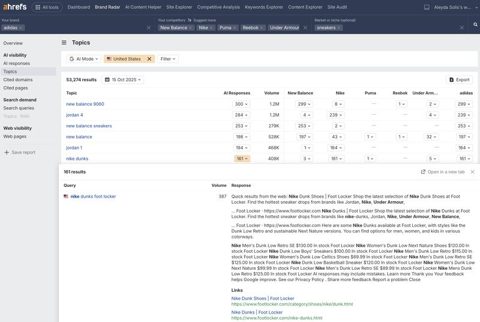 The limits of tracking individual promptsAleyda Solís · LinkedIn
Your context layer is a treasure trove for prompt research

This is where the context layer I've talked about becomes useful. In my writing about extracting expertise through voice, I described it as the knowledge you have that other people can't easily replicate.
AI search visibility: why audio mattersAndrew Riker · LinkedInFor prompt research, that means bringing together what you know about the business, its products, its differentiation, and its customers. Product marketing research. Customer interviews. Sales calls. Support tickets. Surveys. Community discussions. The questions people ask in a webinar after the prepared slides are over.
It's a treasure trove of information for crafting prompts because it contains the language people use when they're confused, comparing options, dealing with a constraint, or trying to make something work. It also contains the reasons they chose you, rejected you, or started looking for an alternative (RIP).
I'd mine that material for recurring questions and phrases, connect them to the buyer and the decision, and use site search and search data to investigate further. Then build prompt groups around those patterns. Use generated prompts to expand the research, and have someone who knows the customer review the result.
The context layer gives the prompt list a reason to exist beyond whatever a tool inferred from your homepage. Those inputs still inform a sample; they don't establish how frequently each prompt is used inside an AI platform.
Balanced needs a definition
We're all figuring this out together. What I recommend will no doubt change as models change and we get better data...at least this is my current way of thinking about it.
An equal split across funnel stages isn't automatically balanced for your business. Neither is a list containing every variation of “best” plus your category.
I'd keep discovery, problem-solving, evaluation, and branded accuracy visible as separate groups. Then decide which groups deserve more attention based on the program's objective.
If you weight them into an executive score, show the weights. A score weighted toward commercial priorities is a management choice. Calling it a measure of total market visibility would require evidence about actual audience demand that the weighting alone doesn't provide.
Prompt counts create weighting even when nobody explicitly sets weights. Fifty versions of one comparison can overwhelm five questions about another product.
Keep a stable core for trend reporting, and put exploratory prompts in a separate group. When the core changes, record the change and establish a comparable baseline. Apply the same discipline to platform, location, model where known, and testing conditions. Repeat the sampling; one answer isn't a durable result. A simulated persona or clean-session API test also won't reproduce every real user's conversation history.
And if this feels overwhelming, I get it, and it's kind of because it is cause we're all figuring out this together in real time. You don't need to feel certain that you've assembled the perfectly curated prompt list. Your measurement will change as you learn. Know your units of measurement: mentions per sampled answer, citations, recommendations, or a defined competitive share. Know which prompts and surfaces those numbers cover, and what performance you're building toward. That's a useful place to start, with room to improve.
Recommendations still need a business test
Wil Reynolds asks the question that belongs alongside every visibility chart: what happened for the business? In his SEO Week interview, he calls for testing whether visibility on relevant prompts corresponds with branded search, service-page traffic, and leads, while checking for other explanations.
 The SEO industry is obsessed with the wrong AI metricWil Reynolds · SEO Week
That's where I'd take this next. Keep mentions, citations, and actual recommendations separate. Read whether the recommendation fits the buyer's stated need, including any caveats. Then examine identifiable AI referrals, qualified demos, purchases, and what buyers tell sales about how they found you.
Branded search and direct traffic can add context, but movement there doesn't establish that AI caused it. Even a tracked AI referral doesn't reveal the full influence of earlier interactions.
Answer-first content for a specific buying question gives you a focused intervention to test. Clear comparisons, credible evidence, accurate product details, and useful implementation guidance can address the uncertainty behind that question. The test still has to establish whether the answers changed and whether there is evidence of a commercial contribution. Publishing more pages and watching a score rise doesn't settle either question.
For the next reporting meeting, bring the prompt list beside the chart. Show which buyer decisions it covers, how the categories are weighted, and what changed since the previous report.
Before that score becomes your North Star, could you explain why those are the questions your business should be guided by? I hope so, and maybe I helped.
Onwards!