
Building AI Search for Enterprise, Part 2: The Biggest Opportunity Isn't Another Tool. It's Getting Everyone Moving Together.
The biggest opportunity in enterprise AI search isn't another tool. It's getting everyone moving together through shared resources, clear ownership, and practical experiments.
By Andrew Riker, Founder, Surfaced

Previously I shared how I approached a global AI search research challenge for a Fortune 50 company. We needed to understand which AI platforms mattered in different markets, who was using them, and how to turn a mountain of conflicting research into something leadership could use.
The result was a living, interactive research resource that teams could revisit as the market changed.
But that leads to another challenge, one I've seen repeatedly throughout my career: What happens after you have the research?
You can have the best insights in the world, a beautiful dashboard, and a strategy that would make any consultant shed a single tear of joy ;)
None of it matters much if the organization isn't equipped to act on it, which is often very much the case from working at enterprise companies like RBC and Intuit inside, and from the outside servicing as Head of SEO at BrightEdge and agency work.
And at enterprise scale, getting people aligned is often harder than figuring out what needs to be done in the first place. Trust.
Search has spent years fighting for a seat at the table
I've worked in search for more than 15 years, recently at Intuit during the early rise of generative AI search.
For much of that time in the biz, search teams have worked from the ground up. We tested hypotheses, chased algorithm changes, built forecasts, connected organic performance to revenue, and made the business case for investment.
Sometimes we won. Sometimes we had to explain for the 47th time why organic traffic wasn't free just because we weren't paying for every click.
That experience made search professionals resourceful. It also created a familiar organizational problem.
SEO became something a specialized team understood deeply, while other functions often engaged only when something needed fixing.
Content teams had their calendars, product teams had their roadmaps, regional marketing teams had their own priorities, analytics had reporting requirements, legal and compliance had perfectly reasonable reasons to say no to things.
Everyone was “doing their job”.
But the search team was often left trying to stitch the pieces together using data to inform strategy, and generative AI has made that arrangement increasingly difficult to sustain as the company looked towards them to find out what’s going on.
A brand's visibility across AI-powered discovery experiences can depend on product information, editorial content, technical accessibility, public reputation, structured data, and information published across the broader web.
No single SEO team owns all of those things. And increasingly, leadership is paying attention and sending those slack messages.
That's an opportunity for search professionals to build something bigger.
The conversation has moved upstairs. The work still happens downstairs.

In my experience, enterprise leaders are increasingly asking questions about AI search that go well beyond rankings….mostly because fear of what they might not know.
Are our brands appearing when customers ask AI platforms for recommendations? Which competitors are showing up? Are buyers getting accurate information about our products? Are we investing in the right places, particularly across regions?
Those are business questions, and they deserve business-level answers.
But executive interest alone doesn't magically create operational alignment.
An executive can declare AI search a priority on Monday and, by Wednesday, five departments can have five different interpretations of what that means.
Activity everywhere. Coordination, nope.
This is where I think enterprise search programs have one of their largest opportunities.
Leadership needs to establish the direction, while search practitioners help translate that direction into repeatable work across the organization.
So, what can we actually build?
This is the part I find particularly exciting.
Historically, building internal resources could require months or even quarters of coordination. You needed a developer, a project brief, an approved budget, a place to host something, and probably three meetings to discuss when to have the next meeting.
Now we can prototype surprisingly useful resources with AI-assisted development tools.
That doesn't mean every search marketer should be building production software.
It means we have another way to solve organizational problems that previously went unaddressed because they weren't worth dedicating an engineering team to.
Think about the things that would make your team's work easier if they existed, like a shared resource where everyone can see what you're learning about AI search. Or a standardized way to compare visibility across brands. A searchable repository of experiments that keeps teams from repeating the same mistakes. All game changers!
These are the types of assets that can make a center of excellence useful.
1. A shared AI search command center
Imagine a single destination where stakeholders across the company can find the information they need about your AI search program.
That might include market trends, current priorities, platform research, experiments, measurement definitions, competitive findings, and links to useful resources.
The goal is straightforward: someone working on a regional content strategy shouldn't need to hunt down the SEO director to understand the organization's AI search priorities.
A shared resource also makes it easier to onboard new people and maintain continuity when responsibilities change.
And importantly, it can be updated as the program evolves instead of becoming another presentation that slowly fossilizes in a shared drive.
2. A prompt and testing library
Enterprise brands often have multiple teams running similar AI search experiments without realizing it.
One market is testing brand visibility for product comparisons, another is evaluating how AI describes its services, and a third is looking at recommendations for specific customer segments.
A shared prompt library creates some consistency.
Teams can see which questions are being tested, the intent behind them, which markets and products they apply to, and how results are collected.
This is particularly valuable for global organizations, where a prompt that makes sense in Boston (hometown!) may be completely irrelevant in Beijing.
I'd also include guidance about the limitations of prompt-based measurement. Responses can vary by platform, location, personalization, and time. A small set of prompts is useful for directional learning, but it shouldn't be presented as a definitive view of market share or performance.
This comes up a lot in my convos lately about build vs. buy, margin of error, statsig, and everything else that goes into search measurement.
3. A reporting prototype everyone can understand
There is no shortage of AI search dashboards, I’m even getting ads for them while watching HBO.
What organizations often lack is agreement on what the numbers mean and what decisions they should influence. Search visibility, citations, mentions, referral traffic, and conversions all tell different parts of the story.
A lightweight reporting prototype can help teams work through those definitions before committing to a complicated implementation.
For example, you could bring together:
- Visibility across a defined collection of high-priority buyer questions.
- Competitor comparisons and how the answers change over time.
- Identifiable AI referral traffic and downstream conversions.
- Content experiments, their hypotheses, and observed outcomes.
- Qualitative findings from sales teams about how buyers are researching.
The point is to establish a common understanding of success, not to create a giant score that nobody trusts.
Once the approach is validated, you have something much more useful to hand over for enterprise-grade implementation.
4. An operational playbook
AI search touches teams with different responsibilities, workflows, and risk tolerances.
An internal playbook can help answer questions like:
Who owns evaluating new AI search platforms? How do we prioritize AI-related content updates? What does legal need to review? How do local teams submit experiments or requests? Who decides whether an approach is ready to scale?
And perhaps most importantly, what do we do when the answer isn't clear?
Not everything needs a forty-page governance document.
Sometimes a straightforward workflow, a few clear owners, and a shared decision log can solve an enormous amount of friction.
5. Education and enablement resources
One of the most overlooked parts of building an enterprise search program is helping people understand why they should care.
Your product team doesn't necessarily need to become expert in retrieval systems. Your CFO DOES NOT WANT a presentation about robots.txt directives.
They do need to understand where their responsibilities connect to the broader AI search strategy.
AI can help build practical, role-specific learning materials, short explainers, FAQs, interactive examples, and internal training resources.
The benefit is that teams become more capable of making good decisions without the search lead needing to personally attend every meeting.
That's how I, and you, build champions.
Pick a problem first. Then decide whether AI should help solve it.
I want to be careful about something here in this rather long-winded dive into the org side of search. It's very easy to get excited about building tools simply because building tools has become easier. AI makes things exciting.
I've certainly fallen into that rabbit hole.
You start by trying to make a small internal dashboard, and two hours later you're wondering whether your company needs a custom authentication system and a mascot.
Probably not. The right place to start is with a problem your teams repeatedly encounter.
Maybe five regional teams are presenting AI search performance differently. Maybe your leadership team can't connect experimentation to business priorities. Maybe you've created excellent research, but nobody knows where to find it.
Start there.
Then ask whether a lightweight resource could improve how the organization works.
A simple way to prioritize what to build:
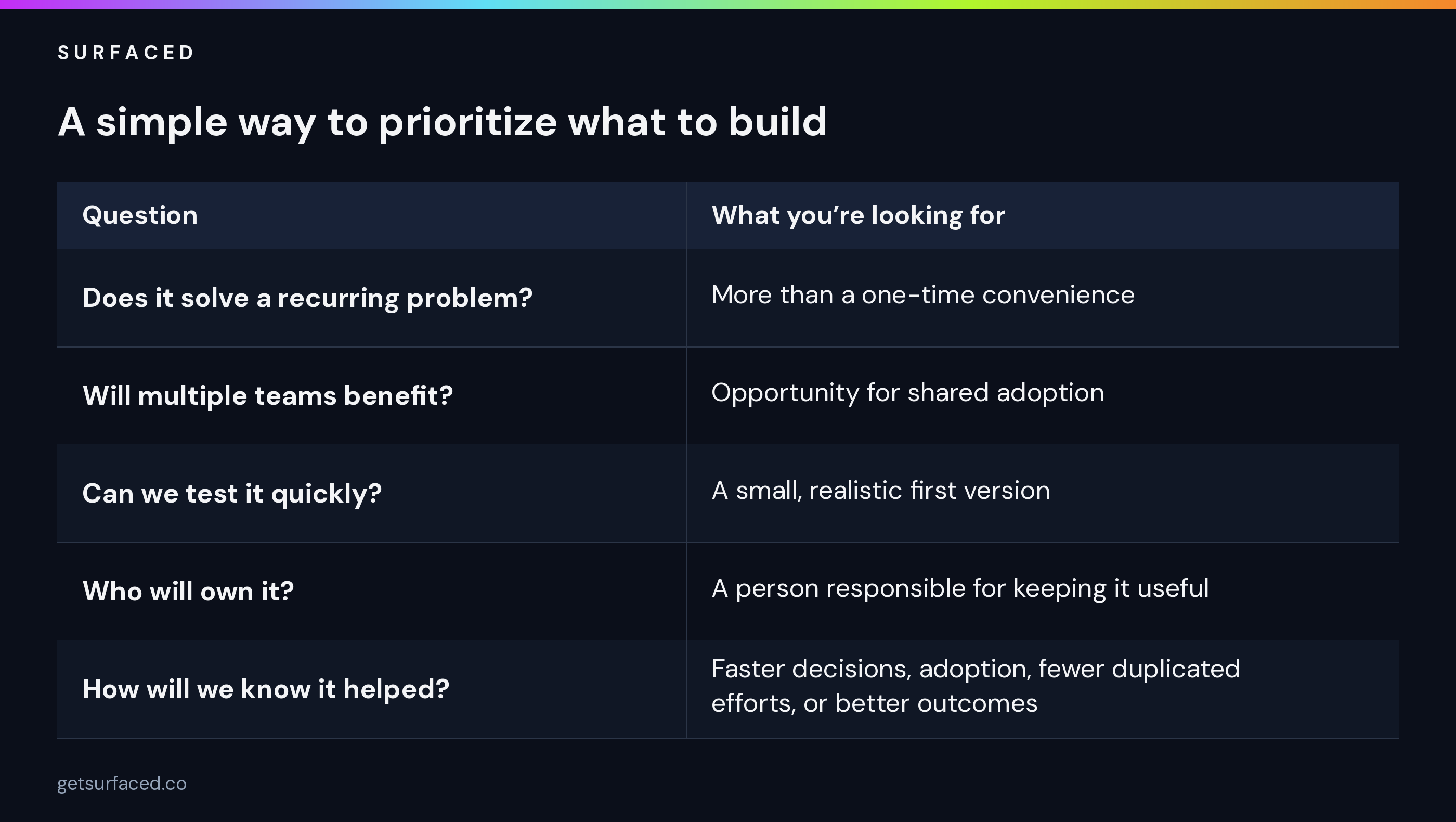
I also think it's worth making a distinction between prototypes and production systems.
AI-assisted coding can be great for an internal proof of concept, educational tool, analysis interface, or lightweight reporting resource.
But once you're handling sensitive company information, introducing complex integrations, or serving large numbers of users, engineering review, security controls, accessibility, data governance, etc and ongoing maintenance become untenable.
Build small to learn quickly. Bring in the right technical expertise when the tool needs to become a durable part of the organization.
A center of excellence should make everyone better at their jobs
I've seen the phrase center of excellence used to describe everything from a highly effective operating model to a recurring calendar invitation with a fancy name.
The version I like is much more practical.
A small group establishes direction, maintains shared resources, helps teams prioritize opportunities, and brings lessons learned back into the broader program.
The teams doing the work remain empowered to make decisions relevant to their products, audiences, and regions.
For AI search, that might mean setting common measurement principles while allowing local teams to evaluate region-specific platforms. Or creating standardized experimentation guidelines without forcing every business unit to prioritize the same content.
Centralizing knowledge shouldn't mean centralizing every decision.
And ideally, the system becomes more valuable as more teams contribute to it.
A successful experiment in one business unit becomes something another can learn from. A regional insight changes global priorities. A question from sales becomes the inspiration for a new content experiment.
That creates a feedback loop instead of another silo.
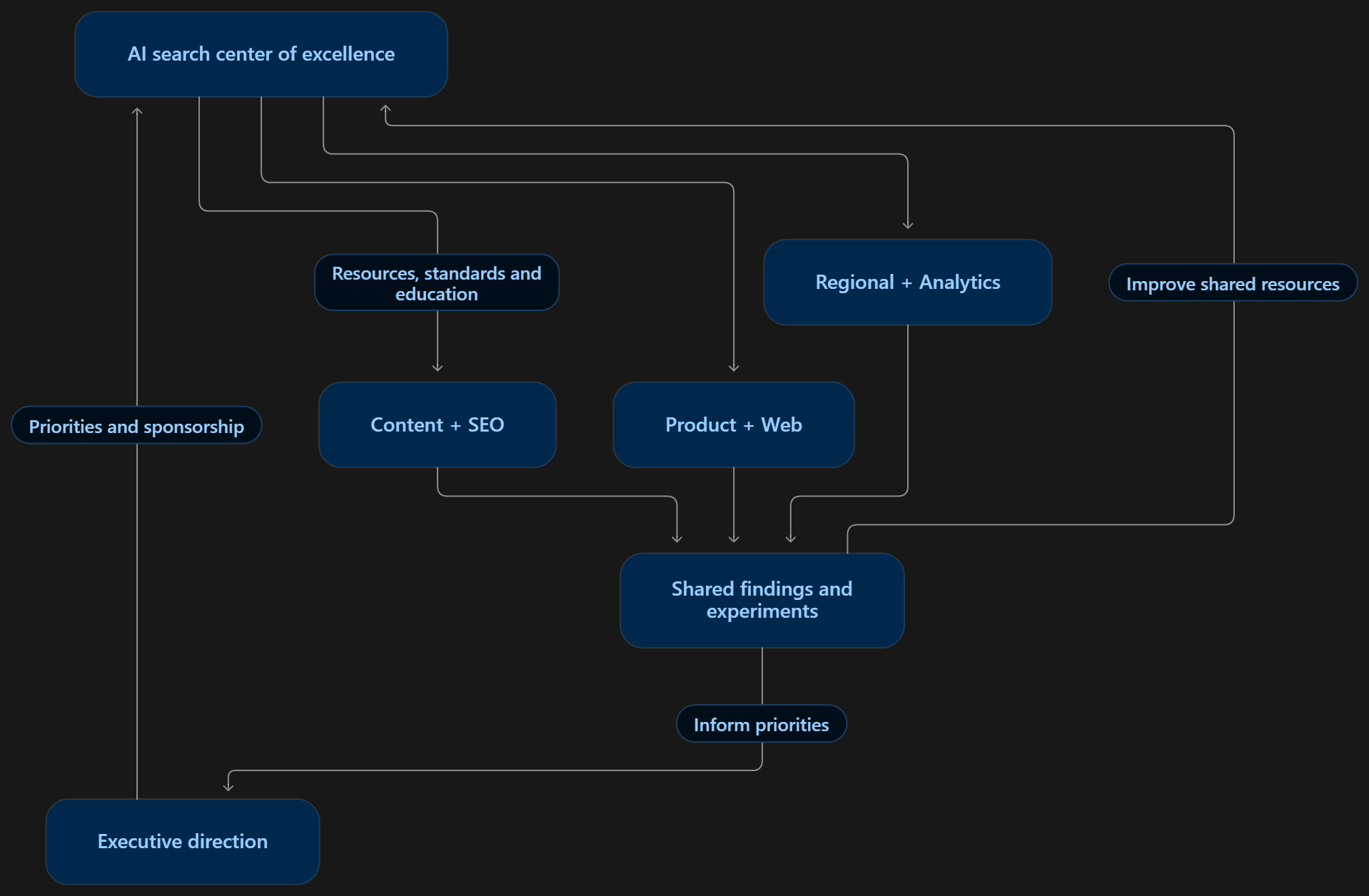
The structure doesn't need to be particularly complicated. Executive leadership helps establish the priorities. A central group maintains resources, standards, and educational materials. Individual teams apply those capabilities to their own work and contribute their findings back into the program.
What I'd do in the first 30 days
If I were standing up this approach inside a large organization, I wouldn't start by building a sprawling AI search platform.
I'd start with a handful of conversations and one useful asset.
Week 1: Find the friction
Talk to search, content, product, analytics, and a leadership sponsor. Identify where priorities, information, and ownership are breaking down.
Week 2: Pick one shared problem
Agree on a resource that solves something real. Define the users, the owner, and what a successful first version should accomplish.
Week 3: Build and test
Use existing documentation and AI-assisted tools to prototype the solution. Put it in front of actual users and see where it helps or falls short.
Week 4: Improve and share
Refine the resource, document ownership, and share what was learned. Decide whether to maintain it, expand it, or retire it.
It's definitely not glamorous. But it's how you begin building something people will actually use.
The opportunity is bigger than a search program
One thing I find encouraging about AI search is that it's bringing familiar search challenges into conversations with people who may never have thought much about SEO before. There are a lot of new AI folks claiming a lot of BS.
And suddenly, there's interest in how brands are described, how information is discovered, what influences recommendations, and how to measure visibility beyond traditional search results.
Search professionals have spent years working on versions of those questions.
We have an opportunity to help organizations navigate this shift, but that requires looking beyond our own channel and bringing more people into the process.
The brands that make progress won't necessarily be the ones building the most sophisticated internal tools. They'll be the ones making it easier for their people to make better decisions, together.
That's where I'd invest!